
Introduction
Learning to code is easier than ever. There are thousands of courses on YouTube, online bootcamps and coding platforms that let people start learning programming from their own homes. Because of this many new learners spend hours watching videos thinking that finishing one course after another will get them ready for a job.
Many students find out that they can follow along with a tutorial but have trouble building even a simple project on their own. They know the rules of the language. They don’t know how to use those rules to solve real problems.
This is when many people fall into what’s often called Tutorial Hell. Of creating websites or apps on their own they keep looking for the next tutorial hoping that it will finally make everything clear.
The truth is that watching tutorials can help you learn ideas but real learning happens when you build something yourself. Each project makes you think carefully solve problems you didn’t expect fix mistakes and make choices that no tutorial can fully teach you.
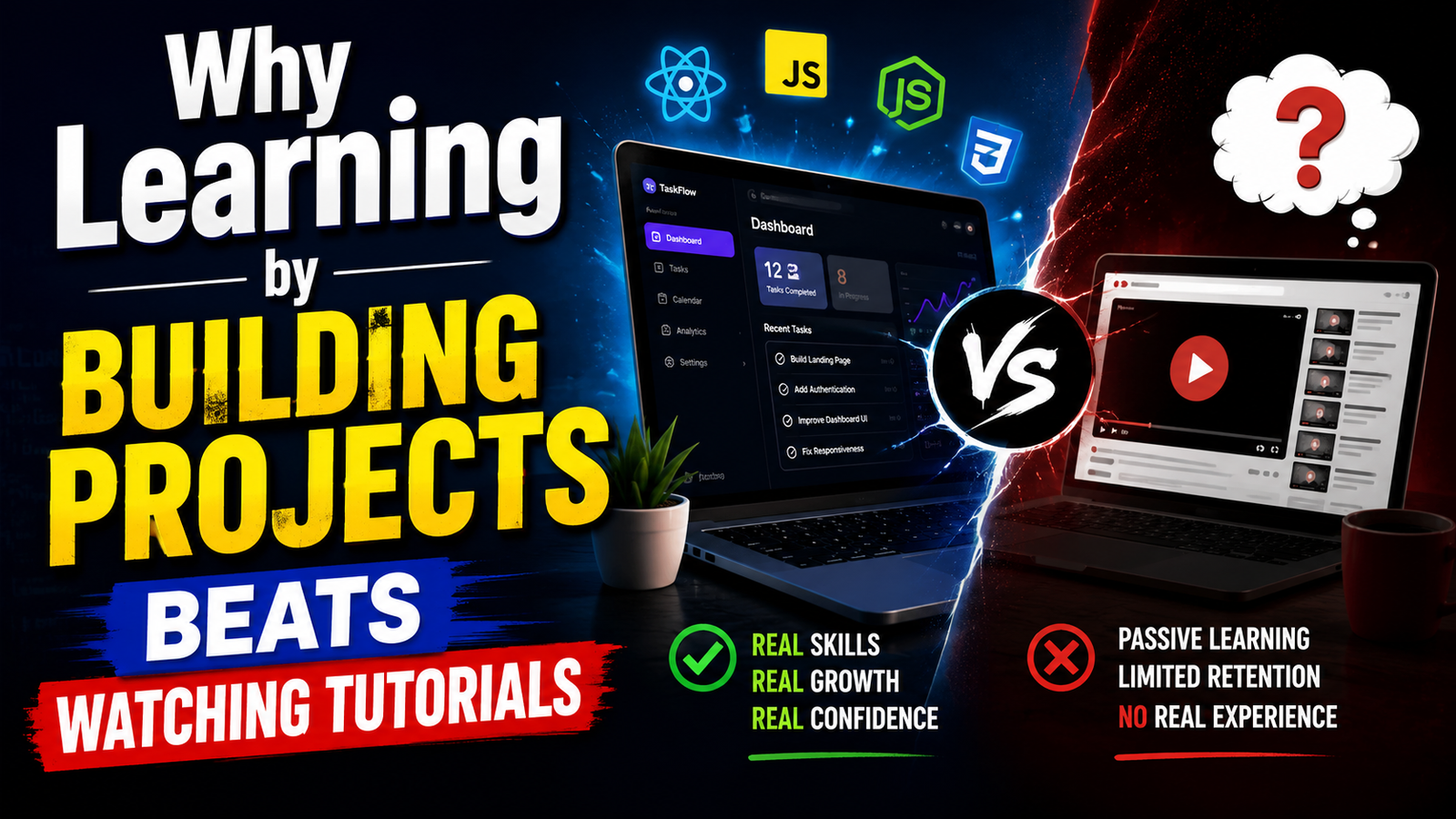
In this guide you will learn why learning by building projects is better than watching tutorials, how projects help you grow as a developer and how you can get out of tutorial hell and become a job-ready programmer.
What Is Tutorial Hell?
Lots of people who are just starting out Web Development or any other stack they are eager to learn. They do one course on HTML then they move on to CSS, JavaScript, React, Node.js and a whole lot of tutorials. Even though they spend a time watching videos, sometimes weeks or even months they still get nervous when someone asks them to make a website on their own without any help.
This is what happens when you are in what people call tutorial hell of using what you learn you start to rely on the teachers to explain everything to you. So you learn a lot of things in theory. You don’t have any ideas to solve problems by yourself.
The problem is not watching tutorials. The problem is that you need them to do every project. You should be able to use HTML and other things you learn to make something without being told what to do that’s why learning by building projects is far much better than watching tutorials.
Why Tutorials Alone Are Not Enough
Tutorials are really helpful when you are learning something. They teach you about ideas they explain how to write the code and they show you how different technologies work. If you a beginner starting with any coding language you can’t write code on your own or learn from any documentation.
Tutorials make everything look easy. They show you a way to do things where everything works correctly. When you work on projects you will have to deal with things that are not working errors that are hard to understand changes that you have to make and problems that you do not expect. Tutorials teach you the basics. Learning to handle these problems is what makes you a real developer.
So tutorials should be the step. Not the end. You should use tutorials to learn and then you should practice + read document side by side while working on real projects to really learn how to develop software. Tutorials are a place to start but you have to keep going and learn from your mistakes to become a good developer.
Why Learning by Building Projects Is More Effective
Before we look at advice lets think about why learning by building projects gives better results than just watching videos. Learning by building projects gives results than just watching videos. Understanding this will help us see the value, in building things ourselves.
1. Projects Help Improve Problem Solving Skills
When you create a project no one tells you what to do. You have to figure out how to arrange your code manage files, correct errors and include features.
Because of this you gain problem solving skills that employers really care about more, than remembering code language. Projects Help Improve your thinking & Problem Solving Skills.
2. You Remember Concepts for Longer
When you watch a tutorial it feels like you know the stuff. But the thing is most people forget what they saw after a days.
On the hand when you build projects you have to do things over and over. Every time you use HTML, CSS, JavaScript or React to fix a problem you get a grasp of HTML, CSS, JavaScript or React. That’s where real learning starts so, learning by doing helps you remember HTML, CSS, JavaScript or React for a time.
3. Projects Build Confidence
A lot of people who are just starting out do not think they can do things on their own. They have never built something by themselves. When you finish a project, a small one you’ll see that you can build something real.
Every time you finish a project you feel more confident about your abilities. You start to think that you can handle projects. Every finished project gives you the confidence to try something with your projects. Projects like these help people build confidence in what they can do, with their projects.
4. You Learn Debugging Naturally
Every developer spends a lot of time fixing problems in code & when coding you’ll deal with various kinds of bugs, code crashes etc. Tutorials often show code without any mistakes but real projects make you deal with typing errors, wrong logic problems with tools and issues when putting things online.
Even though fixing these problems can be annoying, at first but it helps you understand how software really works.
5. Projects Create a Strong Portfolio
Hiring managers don’t usually ask how lessons you have finished. They want to see the things you have made. A collection of projects shows your skills, imagination and how well you can handle real problems.
6. Projects Prepare You for Interviews
Technical interviews often include questions about your projects.
Interviewers may ask:
- Why did you choose this technology?
- What challenges did you face?
- How did you optimize performance?
- What would you improve?
If you’ve built the project yourself, answering these questions becomes much easier.
7. You Learn How Different Technologies Work Together
Normally tutorials are one thing, at a time. They do not show you how everything works together. Projects teach you how HTML, CSS, JavaScript, APIs, databases, authentication, deployment and version control all work together.
You learn how these technologies work together to make applications. This is a deal because it is hard to understand how everything fits together when you are just learning one thing at a time. You get an understanding of how HTML and CSS and JavaScript and all the other technologies work together when you do projects.
8. Projects Teach Research Skills
Developers who work with companies do not have all the answers. They know how to look at the documentation that comes with a project. They can also read the messages that tell them what is going wrong.
Developers can search for a way to fix the problem. They can think about which way is the best way to do it. When people work on projects they get better at doing these things. Working on projects helps people learn how to do research. That is a very useful skill for developers to have. Developers learn how to research by working on projects.
9. You Become Job-Ready Faster
Companies want to hire developers who can actually solve problems, not people with theoretical knowledge. When you build projects all the time you get the kind of experience that companies look for in developers. This experience is really useful when you are applying for internships, freelance work and full-time jobs, as a developer therefore, learning by building projects helps you become a job- developer faster.
10. Every Project Makes the Next One Easier
The first project you work on may take weeks to complete. Each new project becomes easier because you use knowledge you already have write cleaner code and make better technical decisions. Progress builds on itself over time.
How to Learn Effectively Through Projects
If you’re just starting, follow this simple approach:
- Watch a tutorial to understand the basics.
- Close the tutorial.
- Build the same project from memory.
- Add two or three new features.
- Publish the project on GitHub.
- Deploy it online.
- Repeat the process with a slightly more difficult project.
This method combines guided learning with independent practice.
Conclusion
Watching tutorials is a way to start learning how to program but you really start to get better when you use what you learned to make something. When you work on projects you get better at solving problems you feel more sure of yourself you learn how to fix mistakes. You make a collection of work that people who hire can look at.
If you really want to become a programmer you should watch fewer tutorials and make more things yourself. Making projects is an good way to learn skills that you can actually use and get ready for a real job making software.
FAQ: Why Learning by Building Projects Beats Watching Tutorials
Q: Why is learning by building projects better than watching tutorials?
A: Building projects helps you apply what you learn, solve real problems, improve debugging skills, and gain practical experience that tutorials alone cannot provide.
Q: What is tutorial hell?
A: Tutorial hell is a situation where learners keep watching coding tutorials without building projects on their own. As a result, they understand concepts but struggle to create applications independently.
Q: Should beginners stop watching tutorials completely?
A: No. Tutorials are great for learning new concepts and technologies. However, you should use them as a starting point and spend most of your time building projects to strengthen your skills.
Q: What projects should beginners build first?
A: Beginners can start with projects like a calculator, to-do list, weather app, portfolio website, quiz app, or expense tracker before moving on to larger full-stack applications.
Q: How do projects help during job interviews?
A: Projects give you real examples to discuss during interviews. Recruiters often ask about the challenges you faced, the technologies you used, and how you solved problems while building them.
Q: How many projects should I build before applying for jobs?
A: There is no fixed number, but having 3–5 well-built, complete projects that showcase different skills is generally more valuable than having many unfinished or copied projects.